
Against the odds, shining through, eventually recognised.
” I considered her a genius, and I don’t use that word lightly.”1
It is a depressing truism, that women’s work is often undervalued and marginalised and regularly overlooked. In science, as elsewhere, women were and sometimes still are, sidelined, bullied and belittled. Rosalind Franklin is a case in point.
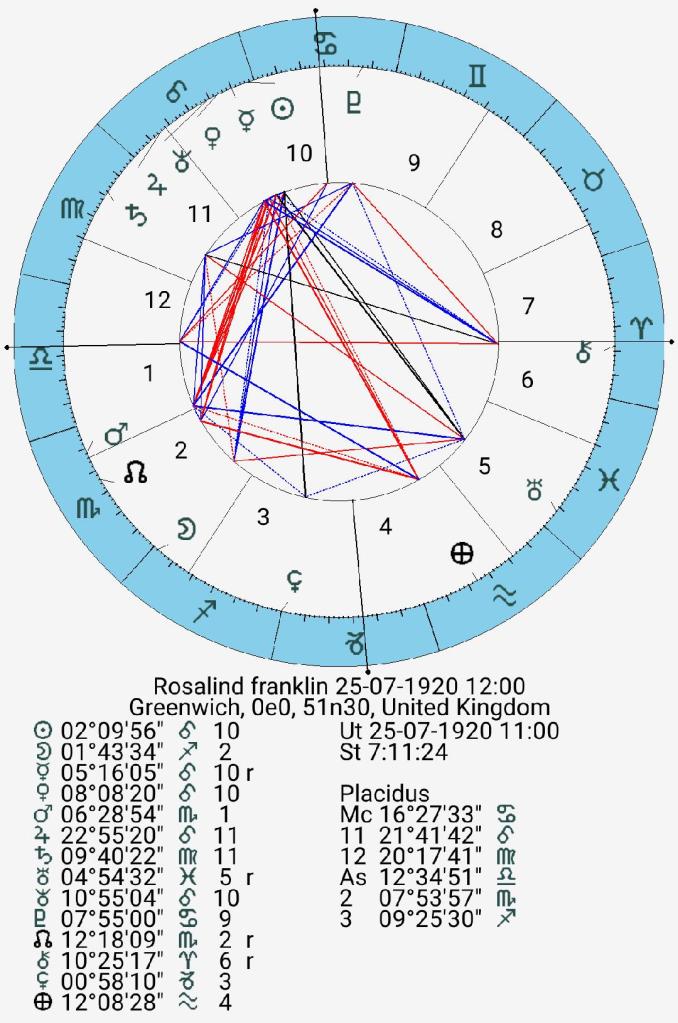
We do not have a birth time for her, so I have used 12.00. But even without the house cusps, we can see a lot. Rosalind has a stellium in Leo, of Sun, Mercury, Venus and Neptune conjunct and Jupiter in a late degree. Her Moon is either in early Sagittarius or late Scorpio.
Rosalind was an English chemist and X-ray crystallographer who made contributions to the understanding of the molecular structures of DNA (deoxyribonucleic acid), RNA (ribonucleic acid), viruses, coal, and graphite. Although her work on coal and viruses were appreciated in her lifetime, her contributions to the discovery of the structure of DNA were largely recognized posthumously.
Born to a prominent British Jewish family, Rosalind was an excellent student. She wished to study science at Cambridge, but her father refused to pay for her to attend. Her aunt, offered to fund her degree and her mother pledged money, which made her father eventually relent and pay for her. Which begs the question of how many brilliant women were lost to the world because their fathers’ vetoed their studies. Others have disputed this story.

Rosalind Franklin. Encyclopedia Britannica. Article created 20 Jul 1998. Fair Use.2
As we do not have the houses in her horoscope, we cannot find her father or her aunt and mother, but looking at her transits for July-September 1938 ( I am assuming her degree lasted three years)we see that Pluto was applying to her Sun at 1’Leo. Throughout her period of study Pluto was moving across her Sun and then her Mercury. Pluto Sun contacts are often life changing, Pluto is exalted in Leo so incredibly powerful. Her will and determination and helpful women (perhaps Pluto is feminine) opened the door for her.
Franklin studied the Natural Sciences Tripos at Newnham College, Cambridge, from which she graduated in 1941, women were not awarded degrees at that time. Earning a research fellowship, she joined the University of Cambridge physical chemistry laboratory under Ronald George Wreyford Norrish, who disappointed her for his lack of professionalism.
When she graduated, Chiron was conjunct her Sun (her life’s work) and Mercury (that brilliant mind). Chiron suggests the battle she may have had within the university or perhaps with the other students. Chiron Sun contacts expose the wound, my guess is she had to prove herself worthy, intelligent enough to her fellow (male) students and her professors.
Rosalind was given a research position by the British Coal Utilisation Research Association (BCURA) in 1942 to work on coals, earning her PhD in 1945. In 1947 she went to Paris as a chercheur (post-doctoral researcher) under Jacques Mering at the Laboratoire Central des Services Chimiques de l’Etat, where she became an accomplished X-ray crystallographer.
In 1942, Chiron was conjunct her Venus, Uranus Saturn were in 2′ Gemini perhaps opposite her Moon if it was in early Sagittarius or if it was in late Scorpio, which I suspect it was, both planets would have be transiting her Moon the year before she was awarded the post. Pluto transits were again prominent that year, Pluto was conjunct her Mercury, and Jupiter was conjunct her Pluto at 4′ Cancer. Of course, Pluto rules X-rays, radiation and microscopic things, so this fits.
When she was awarded her doctorate, in 1945, Pluto was conjunct her Venus at 8′ Leo. In 1947, again, Chiron and Pluto transits show. Chiron was conjunct her Mars at 6′ Scorpio, Pluto was conjunct her Neptune a 11′ Leo and Saturn was conjunct her Sun Mercury at 2-5′ Leo.
In 1951 she moved to King’s College London studying X-ray diffraction which would eventually reveal the double helix of DNA.3 The other DNA researcher, Wilkins, expected she would work with him, perhaps as his assistant, women scientists were often given auxiliary roles, however brilliant they were. 4 The head of the King’s group, John Randall, led Rosalind to believe she would be independent. This caused bad feeling between her and Wilkins from the outset.
Uranus was conjunct her Pluto at 7′ Cancer. Uranus Pluto can very bad-tempered and destructive and also brilliant and inspired. Jupiter was conjunct her Chiron at 10′ Aries, again, that wound. Jupiter expands what it touches, for good or ill.
Cobb, suggests their differences were a personality clash, ‘Wilkins was quiet and hated arguments; Franklin was forceful and thrived on intellectual debate.’ 5 However, it was more likely professional rivalry or simple misogyny or antisemitism. When Rosalind left King’s, Wilkins wrote to Crick, ‘Our dark lady is leaving us next week.’ 6 Which of course, may be a reference to Shakespeare’s Dark Lady or a comment on her ethnicity, to me, it sounds like an anti-Semitic trope.
Rosalind’s friend Norma Sutherland recalled her as forceful and uncompromising:
“Her manner was brusque and at times confrontational – she aroused quite a lot of hostility among the people she talked to, and she seemed quite insensitive to this.”7
Perhaps because Rosalind refused to be the docile, subservient woman expected of her in the 1950s and was not interested in pandering to the male ego.
I wonder if she was either Scorpio or Aries rising, both of which can be abrasive and, in the case of Aries, very sure of themselves, which can be a red-rag to some weak men. If she was Aries rising, she would have had Chiron in the first or twelfth house. Chiron in the first, particularly in Aries, can show a constant need to assert oneself against people that refuse to respect you. On the other hand, if she was Scorpio rising, she would have had that powerful, non-compromising Mars in Scorpio in the twelfth or first house. Mars in Scorpio, may well be described as that ‘dark lady’. Scorpio is the sign of the feminine Mars and co-ruled by Pluto, might explain the many Pluto transits.
It has been argued that Rosalind was ‘difficult’ but perhaps being such a strong Leo type she refused to play second fiddle to ‘the boys’, who treated her with condescension and disrespect. She was not called Dr Franklin, as was her due, but Rosy, which she hated.
‘Clearly Rosy had to go or be put in her place. The former was obviously preferable because, given her belligerent moods, it would be very difficult for Maurice to maintain a dominant position’ James Watson 8
Rosalind had a Stellium in Leo: Sun, Mercury, Venus, Neptune and Jupiter. She was a star and some of her more insecure male colleagues did everything they could to diminish her brilliance. She may also have had Leo pride which reacts negatively when disrespected.
‘Expecting the high standards from others that she constantly demanded of herself, she prompted dislike as well as deep loyalty from colleagues.’9
Rosalind’s work was not ‘stolen’ by Watson and Crick, but her preliminary work was pivotal their discovering the helical structure of the DNA molecule. Photograph 51 taken by Rosalind and R.G.Gosling showed the clearest picture of DNA. Watson says of this, ‘my mouth fell open and my pulse began to race.’ 10
Bernal, head of Physics at Birkbeck said Photograph 51 was,
“amongst the most beautiful X-ray photographs of any substance ever taken”. 11
After Watson saw Photo 51, he went out to dinner with Wilkins and pressed him for an interpretation of the measurements. Watson didn’t know how to interpret a diffraction photo, other than that an “X” meant helix. Watson and Crick were not chemists and made mistakes in the structure. Wilkins, passed on Rosalind’s assessment. 12
Photograph 51 did not reveal the exact chemical structure of DNA. Rosalind’s precise observations from her X-ray crystallography did. Franklin’s data in a 1952 Medical Research Council report inspired Watson and Crick to alter the proposed structure of their model. 13
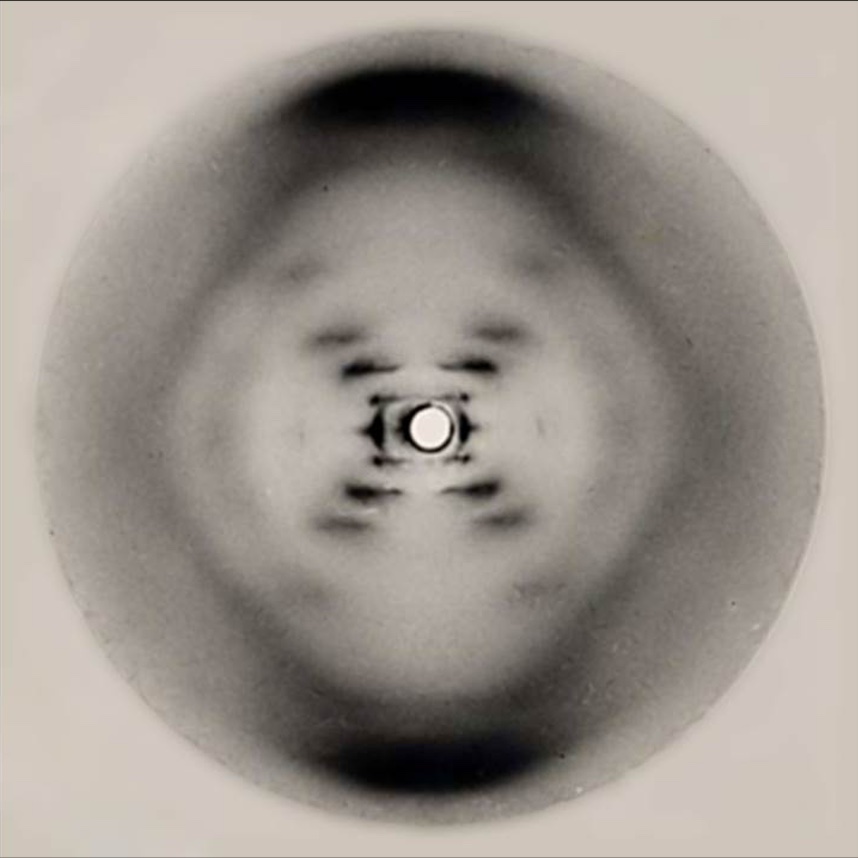
Photo 51, public domain. X-ray diffraction image of the double helix structure of the DNA molecule, taken 1952 by Raymond Gosling, commonly referred to as “Photo 51”, during his work with Rosalind Franklin on the structure of DNA
Ironically, the data provided by Franklin to the Medical Research Council was virtually identical to that she presented at a small seminar in King’s in November 1951, when Jim Watson was in the audience. Had Watson bothered to take notes during her talk, instead of criticising her dress sense and her looks, he would have provided Crick with the vital numerical evidence fifteen months before the breakthrough finally came. 14
In November 1951, Pluto was conjunct her Jupiter at 21′ Leo, while Jupiter was still conjunct her Chiron at 10′ Aries. The Pluto transit continued off and on for three years. This Pluto Jupiter transit would have been in her 10th house, if she was Scorpio rising and fits the breakthrough in her career.
Rosalind’s calculations were included in a brief informal report in 1953 sent to Max Perutz of Cambridge University, who passed this on to Watson and Crick. The report was not confidential but Watson and Crick did not ask anyone at King’s for permission to interpret Franklin’s data, something she was particularly sensitive about, with good reason as it transpired. This data was used by Crick and Watson to build their model of DNA in 1953.
Professor Patricia Fara, President of the British Society for the History of Science (2016-18), Clare College, University of Cambridge wrote,
‘This notoriously unpleasant and complex chain of events was mired in personal misunderstandings, resentments and ambitions, but also reflected contrasting approaches to scientific research. Whereas Franklin adhered to a methodological ideology, Crick and Watson built models as exploratory tools, without waiting until all the data had been compiled. Indeed, in their first brief announcement in Nature¸ Crick and Watson supplied no supporting experimental evidence other than Gosling and Franklin’s photograph 51.’ 15
Maddox suggested they did not cite Rosalind’s work because Watson and Crick would have had to say where the unpublished material had come from and admit they did not have permission to use it. 16 As Maddox writes, ‘Such acknowledgement as they gave her was very muted and always coupled with the name of Wilkins’ 17 who was not involved in Rosalind’s research but had access to her findings. They admitted having “been stimulated by a knowledge of the general nature of the unpublished experimental results and ideas of Dr. M. H. F. Wilkins, Dr. R. E. Franklin and their co-workers at King’s College London”. 18
Franklin and Gosling’s published the DNA X-ray image in the same issue of the scientific journal Nature. Rosalind observed, ‘our general ideas are not inconsistent with the model proposed by Watson and Crick’.19
In his later book, Watson included frank descriptions of his own appalling attitude towards Franklin, whom he tended to dismiss, and patronise. 20
Her very fiery chart, five planets in Leo, show her brilliance and perhaps explain why she encounter such animosity from some colleagues and great loyalty from others. Leo can be both the imperious queen and the super supportive leader. Some saw her as arrogant others and fun and warm, both of course can be true. She would have insisted for recognition for her own work (and her assistants’) which may have caused resentments among lesser men who could not conceive or admit to a woman’s brilliance.
In 1953, after two unhappy years Rosalind left King’s for a research position at Birkbeck College, University of London, a less prestigious college. Jupiter was opposing her Moon during that period, which may have made her want to escape (Jupiter) the things which were making her unhappy (Moon). Established at Birkbeck, Rosalind lead pioneering work on the molecular structures of viruses. After her death, her team member Aaron Klug continued her research, winning the Nobel Prize in Chemistry in 1982.
James Watson, Francis Crick and Maurice Wilkins shared the Nobel Prize in Physiology of Medicine in 1962 for their mapping of the DNA molecule. Watson suggested that Franklin would have ideally been awarded a Nobel Prize in Chemistry, along with Wilkins, but the Nobel Committee does not make posthumous nominations.
‘Franklin’s surviving letters confirm the testimony of friends and family that she was a person of intense feelings and intelligence who was committed to scientific research but also fully enjoyed leisure activities – sports, sewing, traveling, entertaining.’ 21
Rosalind died in 1958 at the age of 37 of ovarian cancer, it has been suggested that her intensive work with X rays may have been a contributory factor. 22
‘Her (Rosalind) devotion to research showed itself at its finest in the last months of her life. Although stricken with an illness which she knew would be fatal, she continued to work right up to the end.’ 23
The sad irony, is that only posthumously, has Rosalind been given the recognition she deserves.

This is taken from my book, Goddess Astrology available from Aeon Books here Other brilliant Leo scientists include, Alice Ball (Leprosy research).
- J. D. Bernal, head of Physics, Birkbeck, University of London in Tyson, Peter. Defending Franklin’s Legacy. NOVA April 2003 https://www.pbs.org/wgbh/nova/photo51/elkin.html ↩︎
- https://www.britannica.com/biography/Rosalind-Franklin : https://cdn.britannica.com/30/99730-050-E68F62FF/Rosalind-Franklin.jpg ↩︎
- Cobb, Matthew. June 23rd 2015. Sexism in Science: did Watson and Crick really steal Rosalind Franklin’s data? Guardian Newspaper, https://www.theguardian.com/science/2015/jun/23/sexism-in-science-did-watson-and-crick-really-steal-rosalind-franklins-data accessed 10.1.2021. ↩︎
- Lee, Jane, J. 19th May 2013. 6 Women Scientists who were snubbed due to sexism. National Geographic https://www.nationalgeographic.com/news/2013/5/130519-women-scientists-overlooked-dna-history-science/ accessed 11.1.2021. ↩︎
- Cobb, Matthew. June 23rd 2015. Sexism in Science: did Watson and Crick really steal Rosalind Franklin’s data? Guardian Newspaper, https://www.theguardian.com/science/2015/jun/23/sexism-in-science-did-watson-and-crick-really-steal-rosalind-franklins-data accessed 10.1.2021. ↩︎
- Maddox, Brenda.2003. Rosalind Franklin The Dark Lady of DNA. Harper Collins, London. cited in https://books.google.co.uk/books?id=leJtDfXvR2kC&source=gbs_navlinks_s accessed 11.1.2021 ↩︎
- Cobb, Matthew. June 23rd 2015. Sexism in Science: did Watson and Crick really steal Rosalind Franklin’s data? Guardian Newspaper, https://www.theguardian.com/science/2015/jun/23/sexism-in-science-did-watson-and-crick-really-steal-rosalind-franklins-data accessed 10.1.2021. ↩︎
- Cobb, Matthew. June 23rd 2015. Sexism in Science: did Watson and Crick really steal Rosalind Franklin’s data? Guardian Newspaper, https://www.theguardian.com/science/2015/jun/23/sexism-in-science-did-watson-and-crick-really-steal-rosalind-franklins-data accessed 10.1.2021. ↩︎
- Fara, Patricia. The Rosalind Franklin Institute https://www.rfi.ac.uk/about/rosalind-franklin/ accessed 11.1.2021 ↩︎
- Cobb, Matthew. June 23rd 2015. Sexism in Science: did Watson and Crick really steal Rosalind Franklin’s data? Guardian Newspaper, https://www.theguardian.com/science/2015/jun/23/sexism-in-science-did-watson-and-crick-really-steal-rosalind-franklins-data accessed 10.1.2021 ↩︎
- Maddox, Brenda. 2003. Rosalind Franklin: The Dark Lady of DNA. London: Harper Collins. P.153. ↩︎
- Tyson, Peter. Defending Franklin’s Legacy. NOVA April 2003. https://www.pbs.org/wgbh/nova/photo51/elkin.html ↩︎
- Tyson, Peter. Defending Franklin’s Legacy. NOVA April 2003. https://www.pbs.org/wgbh/nova/photo51/elki-glossary.html#bern ↩︎
- Cobb, Matthew. June 23rd 2015. Sexism in Science: did Watson and Crick really steal Rosalind Franklin’s data? Guardian Newspaper, https://www.theguardian.com/science/2015/jun/23/sexism-in-science-did-watson-and-crick-really-steal-rosalind-franklins-data accessed 10.1.2021. ↩︎
- Fara, Patricia. The Rosalind Franklin Institute https://www.rfi.ac.uk/about/rosalind-franklin/ accessed 11.1.2021. ↩︎
- Maddox, Brenda. 2003. Rosalind Franklin: The Dark Lady of DNA. London: Harper Collins. P.207 ↩︎
- Maddox, Brenda. 2003. Rosalind Franklin: The Dark Lady of DNA. London: Harper Collins. P.316-7. ↩︎
- Watson, J. D., Crick, F. H. (April 1953). “Molecular structure of nucleic acids; a structure for deoxyribose nucleic acid”. Nature. 171 (4356): 737–738. Watson and Crick’s article was immediately followed by the two King’s College London submissions: Wilkins, M. H., A. R. Stokes, H. R. Wilson (April 1953). “Molecular structure of deoxypentose nucleic acids”. Nature. 171 (4356): 738–740. then by: Franklin, R. E., R. G. Gosling (April 1953). “Molecular configuration in sodium thymonucleate”. Nature. 171 (4356): 740–741. ↩︎
- Franklin, Rosalind E.; Gosling, R. G. (25 April 1953). “Molecular Configuration in Sodium Thymonucleate” (PDF). Nature. 171 (4356): 740–741 ↩︎
- Cobb, Matthew. June 23rd 2015. Sexism in Science: did Watson and Crick really steal Rosalind Franklin’s data? Guardian Newspaper, https://www.theguardian.com/science/2015/jun/23/sexism-in-science-did-watson-and-crick-really-steal-rosalind-franklins-data accessed 10.1.2021. ↩︎
- Fara, Patricia. The Rosalind Franklin Institute https://www.rfi.ac.uk/about/rosalind-franklin/ accessed 11.1.2021. ↩︎
- Tyson, Peter. Defending Franklin’s Legacy. NOVA April 2003. https://www.pbs.org/wgbh/nova/photo51/elkin.html Accessed 11.01.2021. ↩︎
- Bernal, John Desmond. https://www.azquotes.com/quote/997587 accessed 12.01.2021. ↩︎
 Elisabeth Brooke
