

Artemis pouring a libation. Attic white-ground lekythos, c. 460–450 BCE. From Eretria. Attributed to Bowdoin painter. Louvre, Paris. Public domain. Jastrow 2006.
‘I sing of Artemis of the golden bow, boisterous, august maiden, deer hunting, shooter of arrows, sister of Apollo of the golden sword. Delighting in the hunt, down the shady hills and the windy mountaintops, stretching out her golden bow, releasing whispering arrows. And the tops of lofty mountains tremble and the thick woodland echoes with the terrible screams of wild beasts and the land shakes and the fish-filled sea. She has a brave heart, and, on every side, she turns around and kills the race of wild beasts. But when, this hunter of wild beasts is satisfied and her heart is cheered, releasing her well-worn bow, she comes to the great palace of her beloved brother Phoebus Apollo in Delphi, that abundant place. Putting on the beautiful dances of the Muses and the Graces. There, she hangs up her unstrung bow and arrows and, beautifully dressed, she leads the dance.’ Homeric Hymn to Artemis, 27.
I give Artemis to Sagittarius in my book Goddess Astrology. She fits the sign so well. There is a wildness about Sagittarius, they operate on a large scale and love to roam, as well as put on their glad-rags and dance.
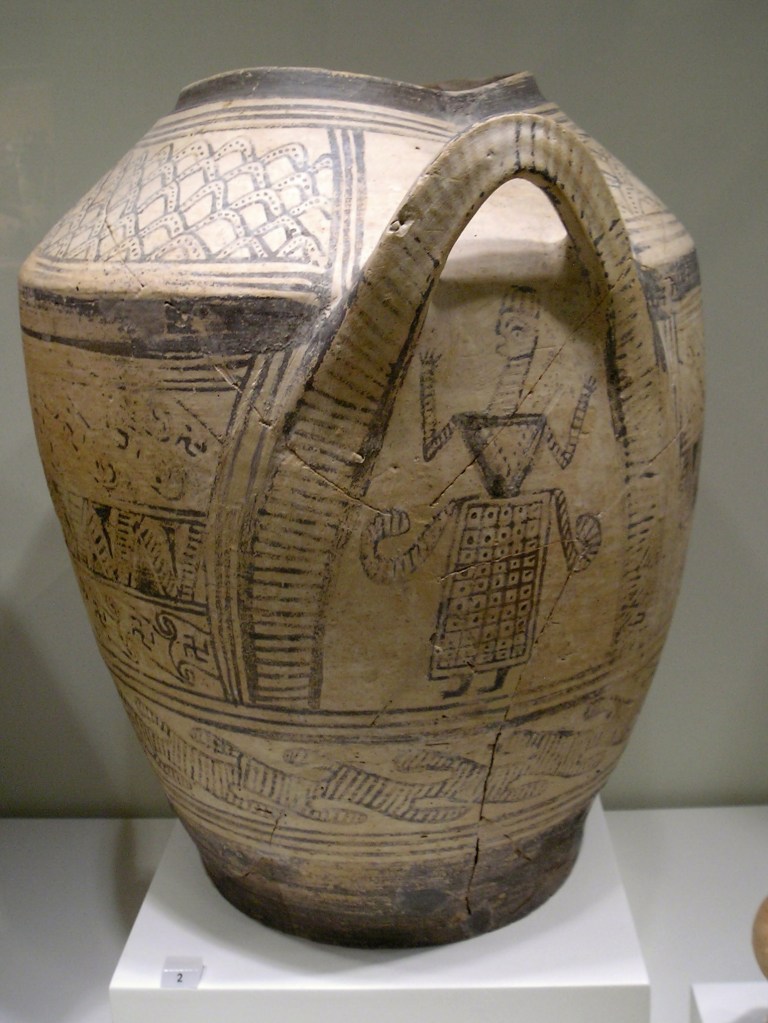
The origin of her name suggests Artemis was a pre-Hellenic goddess. It is believed that a precursor of Artemis was worshiped in Minoan Crete as the goddess of mountains and hunting, she was called Britomartis in the east and Diktynna in the west of the island. In Mycenaean Greek, Artemis or a-te-mi-to /Artemitos/ (a genitive form) and a-ti-mi-te /Artimitei/ (in the dative) has been found written in Linear B at the place complex in Pylos. Other scholars suggest her name comes from arktos (αρκτος) which means bear.
Sanctuaries of Artemis were always in liminal spaces, often at the borders of countries, usually in the wild countryside, the sea or mountainous areas. Building a sanctuary was one way of marking a boundary line between communities. As many rituals to Artemis were women only, it meant women had to rely on the goddess to protect them. The location of her sanctuaries epitomised the wildness of the goddess herself.
Freedom is the word for Artemis, when Zeus offers her cities, she declines saying she does not visit them much. Her home is in the remote mountaintops of Greece. She is described as a virgin goddess, but perhaps unmarried might be a better way to put it. She is not interested in domesticity or the legal and social restraints put on married women and mothers. She wishes to be free, and she wishes all beings to be free. She both hunts animals and protects their young. As a hunter she has a keen eye and a sharp point, she goes for the kill and from the beginning she is dedicated to nature and the outside life where she has agency and control.
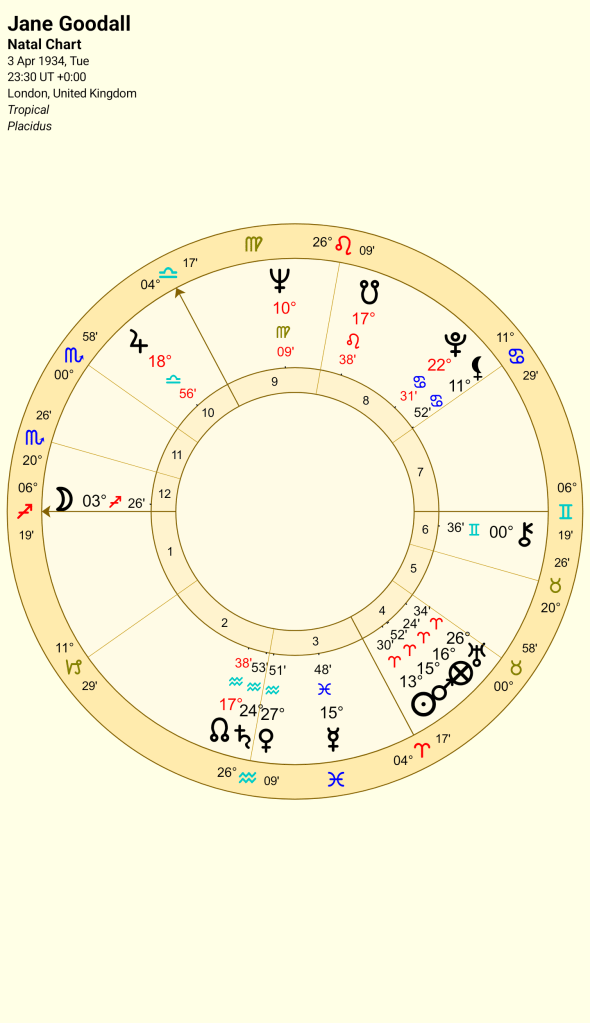
The animal protector: Jane Goodall. 3.Apr.1934. 23h30 London
‘I don’t have any idea of who or what God is. But I do believe in some great spiritual power. I feel it particularly when I’m out in nature. It’s just something that’s bigger and stronger than what I am or what anybody is. I feel it. And it’s enough for me.’
Jane Goodall is a primatologist, ethologist, and anthropologist. She was well-known for her sixty year study of chimpanzee social and family interactions in Gombe Stream National Park, Tanzania. She was the founder of the Jane Goodall Institute[i]and the programme and has worked extensively on conservation and animal welfare issues. She served on the board of the Nonhuman Rights Project since its founding in 1996. In April 2002, she was named a UN Messenger of Peace and is an honorary member of the World Future Council
Jane’s research showed that behaviour which was believed to be uniquely human was shared by chimpanzees. They have strong mother and child and sibling bonds, show compassion, comfort others when mourning and will adopt orphan chimps.[ii] She also observed behaviours such as hugs, kisses, pats on the back, and even tickling, what we consider “human” actions. Goodall insists that these gestures are evidence of
“the close, supportive, affectionate bonds that develop between family members and other individuals within a community, which can persist throughout a life span of more than 50 years.”[iii]
Although she has a strong Sun Mars conjunction in Aries, Jane has her Moon conjunct her Ascendant in Sagittarius showing the area of life she chose to express her unique skills. Being an Aries, she is a trail blazer, opening up the way for women to work in the field in primatology. For her first trip to Gombe, her mother had to go with her, as the authorities wouldn’t let a woman be alone there, (hats off to her mother for supporting her). Her passion for animals is seen in any films of her, but she had the scientific discipline to report negatives, meat-eating and warmongering behaviour of the apes.
Goodall wrote in 1993: ‘When, in the early 1960s, I brazenly used such words as ‘childhood’, ‘adolescence’, ‘motivation’, ‘excitement’, and ‘mood’ I was much criticised. Even worse was my crime of suggesting that chimpanzees had ‘personalities’. I was ascribing human characteristics to nonhuman animals and was thus guilty of that worst of ethological sins -anthropomorphism.’[iv] Rather than numbering the chimps, as was the custom, Jane gave them names, which allowed her to develop a close bonds with them and to become, it is believed, the only human ever accepted into chimpanzee society. Jane was the lowest-ranking member of the troop for twenty two months, until Frodo, an aggressive chimp, attacked her and when he became the alpha male forced Jane to leave the troop.
Jane’s influence has inspired several generations of women to enter the field of primatology. When she began her research in the 1950s it was a male-dominated discipline, today there are equal numbers of men and women. Jane earned her doctorate at Cambridge in ethnology in1965 on the Behaviour of free-living chimpanzees, using data from her first five years at the Gombe Reserve. Although she had no undergraduate degree, she became only one of eight people to be awarded a PhD in this way. Such ‘rule breaking’ is typical of an Aries Sun. who feels no need to play by the rules.
In 1977, Goodall established the Jane Goodall Institute (JGI), which supports the Gombe research, and campaigns to protect chimpanzees and their habitats.
‘When legendary scientist Jane Goodall first came to Tanzania more than 35 years ago to study the chimpanzees of Gombe National Park, the vast, flourishing forest teemed with apes. Today, the park is ravaged by logging, and home to only about 40 chimps, who live confined to a few protected square miles.’1
JGI has nineteen offices around the world and is celebrated for community-centred conservation and development programs in Africa. Roots and Shoots works with young people worldwide, it began in 1991 when a group of sixteen local teenagers met with Goodall at her home in Dar es Salaam, Tanzania. They brought to her their concerns over pollution in the city, deforestation in the mountains and the welfare of both wild and domestic animals. Jane attended their meetings but the group was run by the young people. Their first project concerned the welfare of chickens in villages and in the markets. Jane’s model for youth led activism, helped by resources and leaders from Roots and Leaves has now grown into a worldwide movement of over ten thousand groups in over one hundred countries.[ii]
Sagittarius has a broad reach and often has overseas connections. Prior to the virus (2020) it was said Jane travelled over three hundred days per year. Jane has campaigned about climate change, has met Greta Thunberg (see Capricorn p.xx) and campaigns against animal testing. She is a vegetarian and promotes the diet for ethical, environmental, and health reasons. In, The Inner World of Farm Animals, Goodall writes that farm animals are,
‘…far more aware and intelligent than we ever imagined and, despite having been bred as domestic slaves[iii], they are individual beings in their own right. As such, they deserve our respect. And our help. Who will plead for them if we are silent?’ [iv]
Goodall has also said:
“Thousands of people who say they ‘love’ animals sit down once or twice a day to enjoy the flesh of creatures who have been treated so with little respect and kindness just to make more meat.”
Her easy going sanguine Sagittarius Moon and Ascendant gives her a warm, non-threatening personality and also a great sense of humour. Gary Larson drew a cartoon showing two chimpanzees grooming. One finds a blonde human hair on the other and inquires, “Conducting a little more ‘research’ with that Jane Goodall tramp?”. Jane was in Africa at the time, and the Jane Goodall Institute thought this was in bad taste and had its lawyers draft a letter to Larson and his distribution syndicate in which they described the cartoon as an “atrocity”. When Jane saw the cartoon, she was amused and had the cartoon printed on a tee shirt and sold it to raise funds for the Institute. She wrote a preface to The Far Side Gallery 5, giving her account of the incident. Jane praised Larson’s cartoons, which often compare the behaviour of humans and animals. In 1988, when Larson visited Gombe, he was attacked by a chimpanzee named Frodo (who perhaps felt the need to protect Jane).[v] Jane embodies the Artemisian love of animals, wild places, young people and connections across the globe, as well as a keen sense of humour and playfulness.
[i] Jane Goodall’s Wild Chimpanzees. March 3 1996. PBS Nature. https://www.pbs.org/wnet/nature/jane-goodalls-wild-chimpanzees-introduction/1908/ accessed 3.2.2021.
[ii] http://www.rootsandshoots.org/aboutus/history accessed 3.2.2021.
[iii] See also Sharron Gannon, p.xx
[iv] Hatkoff, Amy. 2009. The Inner World of Farm Animals, Stewart, Tabori and Chang. Lond. p. 13
[v] Larson, Gary. The Prehistory of the Far Side: a 10th-anniversary exhibit. Kansas City, MO: Andrew and McNeel, 1989.
[i] http://www.janegoodall.org
[ii] https://www.janegoodall.org/our-story/our-legacy-of-science/ accessed 30.7.2020.
[iii] Jane Goodall’s Wild Chimpanzees. March 3 1996. PBS Nature. https://www.pbs.org/wnet/nature/jane-goodalls-wild-chimpanzees-introduction/1908/ accessed 3.2.2021.
[iv] Goodall, Jane (1993). Cavalieri, Paola (ed.). The Great Ape Project: Equality Beyond Humanity Fourth Estate, London. p. 10.
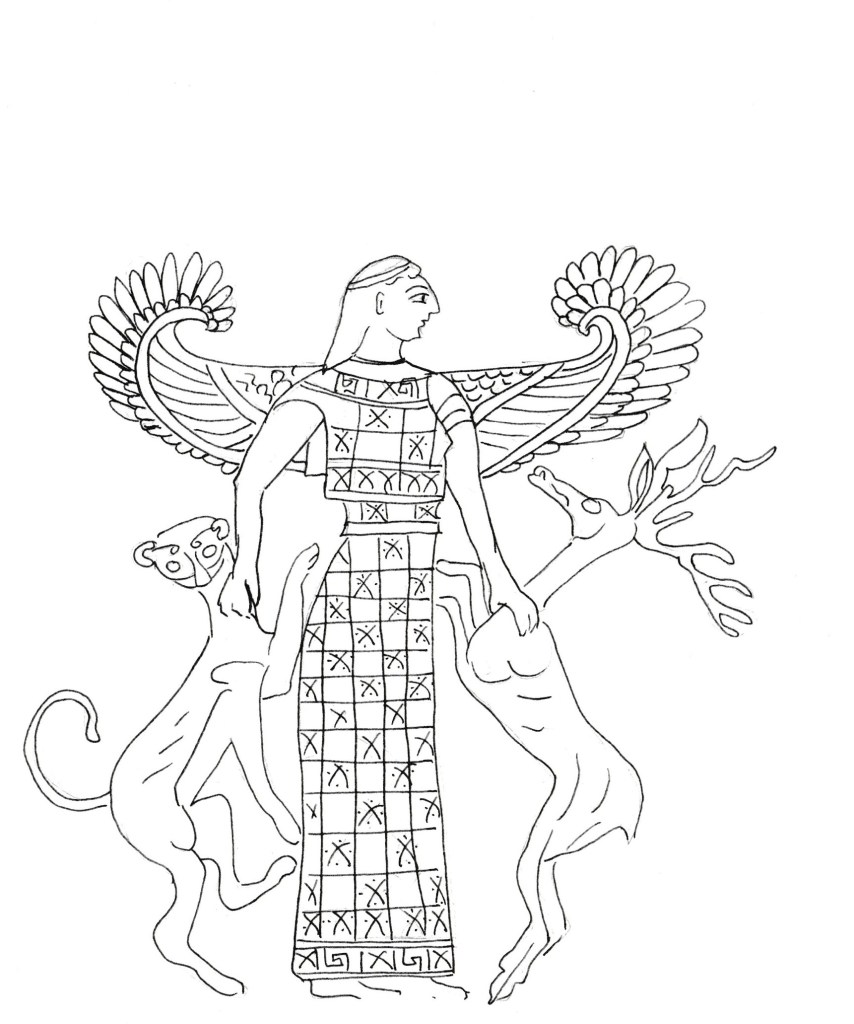
Artemis, Potnia Theron: Lady of the Wild Things
Artemis is one of the two goddesses, (see Hestia) who are immune to Aphrodite’s spell. She has no interest in the romantic love Aphrodite offers and prefers to have the wind in her hair as she explores the remote places. Another traveling pioneer, anthropologist Margaret Mead who reported on women in remote places had Sun, Mercury and Uranus in Sagittarius.
Artemis does, however, know how to have fun. There is a Greek saying, ‘where has Artemis not danced?’ Sagittarius is known for their love of music, dance, socialising and fun. It is not surprising that many musicians are found under her sign. Taylor Swift, Billy Eilish and Miley Cyrus are examples that come to mind.
More info in the book. Buy here
- Jane Goodall’s Wild Chimpanzees. March 3 1996. PBS Nature. https://www.pbs.org/wnet/nature/jane-goodalls-wild-chimpanzees-introduction/1908/ accessed 3.2.2021.
[1] http://www.rootsandshoots.org/aboutus/history accessed 3.2.2021. ↩︎
 Elisabeth Brooke